Understanding the 4F Crisis: When Geopolitics Hits the Balance Sheet

Introduction
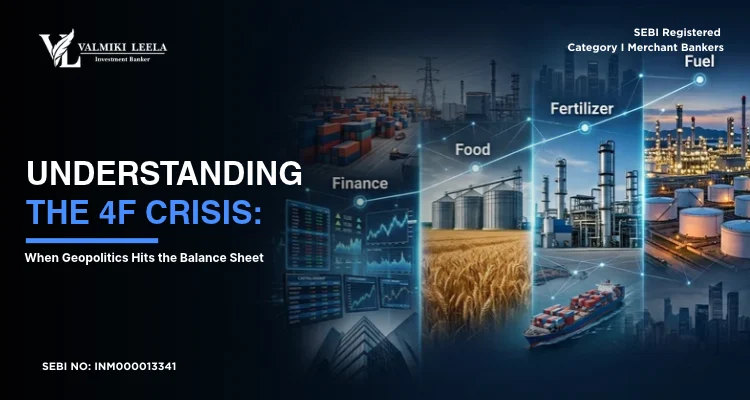
Food. Fuel. Fertilizer. Finance.
The next economic shock may not start in a financial market. It could start much earlier, somewhere in the global supply chain. A disruption in a shipping route, a shortage of fertiliser, a spike in energy prices or a poor harvest can quickly move from commodities to business costs, inflation and eventually the cost of capital.
External Affairs Minister S. Jaishankar’s recent warning about a possible ‘major food crisis’ brings this interconnectedness into focus. Disrupted grain shipments, fertiliser shortages, energy-market volatility and climate risks are no longer isolated issues.
The bigger takeaway is how closely the 4Fs are connected: fuel, food, fertilizer and finance.
A shock in one can quickly create pressure across the others, and businesses ultimately feel it through margins, working capital and financing costs. That is what makes this more than a food-security story. It is increasingly a business and capital-markets story too.
1. Fuel:
Energy is often the first domino.
When energy becomes more expensive, the pressure doesn’t stop at the pump. It moves through manufacturing, transportation, fertiliser, food processing, logistics and power generation, raising costs across the economy.
For an energy-importing country like India, a sustained rise in crude prices can put additional pressure on inflation, the current account and corporate margins.
Recent disruptions to Russian crude supplies have also pushed Indian refiners to look for costlier alternatives, showing how quickly geopolitical developments can translate into higher input costs.
Fuel inflation rarely stays within the energy sector. It travels through the economy.
2. Fertilizer:
Fertilizer is one of the less visible but more critical links in the global food chain.
Russia is a major supplier to global fertilizer markets, while several key fertilizer producers and supply routes are located in the Middle East. Conflict-related disruptions therefore create a double risk:
Higher energy costs + lower fertilizer availability.
India is particularly exposed because it imports both fertilizer products and feedstocks. Disruptions to energy supplies from West Asia can therefore affect domestic fertilizer production as well as imports. The impact is not always immediate. It works through the agricultural cycle. Higher input costs today can eventually translate into higher food prices tomorrow.
3. Food:
This is where the impact starts reaching households and consumers.
It is not enough for food to be available. It also needs to move smoothly from farms to markets and eventually to consumers. That means reliable shipping routes, affordable inputs and functioning trade and financing systems.
Jaishankar has raised concerns about disruptions to grain shipments, particularly through the Black Sea, along with the added risk from a potentially severe El Niño.
That matters because a disruption anywhere along the chain can push up the final price for consumer.
And food inflation has a much wider impact than just the grocery bill. It affects household spending, government subsidies, interest-rate expectations and, ultimately, consumer demand across the economy.
4. Finance:
This is perhaps the part of the story that gets overlooked.
When geopolitical uncertainty rises, investors usually become more cautious. Money can move towards safer assets, while emerging markets may see weaker liquidity and higher funding costs.
For companies, that can have a very practical impact. Borrowing becomes more expensive, refinancing gets harder, and businesses with weaker balance sheets feel the pressure first.
That is where the link between geopolitics and finance becomes important. A shock that starts with oil, food or fertilizer can eventually show up in inflation, interest rates and the cost of capital. The disruption may begin outside financial markets. But sooner or later, financial markets price it in.
Why This Matters for Corporate India
For businesses, the real question is not simply: “Will food prices go up?”
It is where that increase eventually shows up in the business. For some companies, higher input costs can put pressure on margins. Others may have enough pricing power to pass those costs on to customers. Some may even benefit if supply becomes tighter.
There can also be less obvious effects. Companies may need to carry more inventory, lock up more working capital, or deal with greater currency volatility if they depend on imports.
The same global shock can therefore mean very different things for different businesses. That is where understanding the business model, margins and balance sheet becomes more important than simply looking at the headline macro number.
The Second-Order Effects Matter More
The headline may be “Food crisis.”
But for businesses and investors, the bigger question is what comes next.
What happens to fertiliser companies, agricultural inputs, FMCG margins, logistics costs and oil refiners? What does it mean for rural consumption, government subsidies, interest rates and corporate borrowing costs?
That is where the story moves beyond food security and into capital markets. A geopolitical shock does not just change the price of one commodity. It can change the cost structure, margins and financing environment across entire industries.
India's Resilience Will Matter
India is not starting from the same position as every emerging market. Domestic food production, strategic reserves, diversified sourcing, government intervention and the ability to redirect trade flows can provide buffers.
But resilience is not the same as immunity.
India remains exposed to global energy prices, fertilizer availability, shipping routes, currency movements and international capital flows. The challenge is therefore not eliminating external shocks. It is building enough economic and financial resilience to absorb them.
What Should Businesses Be Watching?
For corporate leaders, the next few quarters warrant attention to five variables:
01. Energy Prices
Because energy is embedded across the supply chain.
02. Fertilizer Availability & Pricing
Because today's agricultural input constraints can become tomorrow's food inflation.
03. Global Shipping Routes
Because supply-chain security increasingly has economic value.
04. Capital Flows & Interest Rates
Because geopolitical risk can change the cost and availability of capital.
05. Corporate Margins
Because ultimately, macroeconomic shocks become business problems when they reach earnings.
The Bigger Capital Markets Question:
The 4F crisis points to a bigger change in how businesses and investors need to look at risk.
Growth and valuation still matter, but they are no longer the whole story. Increasingly, questions around supply chains, energy security, dependence on a few markets, input costs and balance-sheet strength are becoming just as important.
A company that can secure its key inputs, diversify its supply chain and maintain access to capital has a stronger cushion when the external environment turns difficult. In a more uncertain world, resilience is becoming an economic advantage, not just a risk-management exercise.
From Geopolitics To Capital Allocation
The biggest takeaway from the 4F crisis is not simply that one commodity could become more expensive. It is how quickly a disruption in one part of the world can ripple through the wider economy.
- A conflict can disrupt shipping.
- That can affect energy and fertilizer supplies.
- Higher input costs can push up food prices.
- Food inflation can influence monetary policy.
- And changes in rates and liquidity can affect capital flows and company valuations.
That is how a geopolitical event can eventually become a capital-markets story. For businesses and investors, following that chain is becoming just as important as watching the initial headline.
Conclusion
The 4F crisis shows how geopolitics can move from supply chains to inflation, corporate margins and capital markets.
For businesses, resilience is no longer just operational it is a capital strategy.
The next opportunity or risk may lie in the second-order effects.
Valmiki Leela Capital Strategic Capital. Enduring Value.
Explore our advisory capabilities: www.valmikileela.com