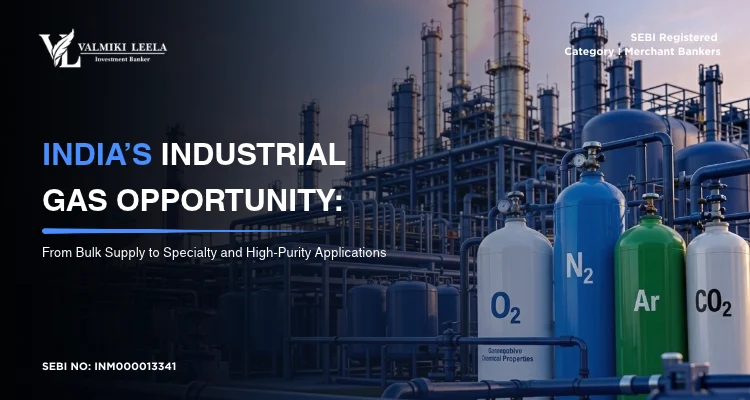
India’s Industrial Gas Opportunity: From Bulk Supply to Specialty and High-Purity Applications

Introduction
India’s next manufacturing cycle will require more than factories, capital and technology. It will also require the gases that keep these ecosystems running. From steel and chemicals to healthcare, electronics and semiconductors, industrial gases are an essential input across India’s expanding manufacturing base. As demand evolves, the opportunity is also moving beyond bulk volumes towards high-purity and application-specific gases.
A Market Linked to India’s Industrial Growth
India’s industrial gases market was estimated at US$1.75 billion in 2025 and is projected to reach US$2.37 billion by 2030, implying a 6.3% CAGR. Growth is being supported by industrialisation, infrastructure investment and expanding manufacturing capacity.
The market remains anchored by bulk gases, particularly oxygen and nitrogen. However, the opportunity is increasingly shifting towards applications where purity, reliability, proximity and specialised supply infrastructure matter as much as volume. This creates an interesting transition: from supplying a commodity input to becoming an integrated part of a customer’s manufacturing infrastructure.
From Bulk Gases to Specialty Gases
According to IMARC, India’s specialty gases market was worth around US$416.9 million in 2025 and is expected to reach US$703.5 million by 2034. The growth is being supported by areas such as electronics, healthcare, renewable energy and, increasingly, semiconductor manufacturing.
What makes this segment different is the level of precision involved. In many applications, these gases are not simply another industrial input. Their purity and consistency can directly influence the manufacturing process, particularly in electronics and semiconductor applications.
The list includes Key gases used across these applications include ultra-high-purity ammonia, silane, ultra-high-purity methane, nitrous oxide, ultra-high-purity oxygen, boron trichloride, deuterium, hydrogen chloride and hydrogen bromide.
That is what makes the segment interesting. As manufacturing becomes more specialised, the requirements from its suppliers also become more demanding. A gas may look like a small part of the overall manufacturing chain, but when purity and consistency are critical, it becomes an important part of the process.
Semiconductors Could Become a New Demand Engine
India’s semiconductor ambitions are creating opportunities far beyond chip manufacturing. One area expected to see growing demand is specialty gases and the infrastructure required to handle, store and supply them.
As of September 2026, the government said investment commitments of around ₹1 lakh crore had been received under Semicon 2.0, with close to 1 lakh employment opportunities expected across the ecosystem. The programme covers not just semiconductor fabs and packaging, but also equipment, materials, R&D and talent.
This broader approach is important because semiconductor manufacturing depends on a much wider supply chain. Specialty gases, for instance, are critical to several stages of chip production, where purity, consistency and reliable supply are essential.
The focus on localisation is also becoming more visible. At SEMICON India 2026, industry participants highlighted the need to build domestic capabilities in semiconductor materials and gases. INOX Air Products said it currently manufactures around 12 semiconductor gases in India and is working to add another 10, while acknowledging that certain gases will continue to be imported.
The value chain, therefore, is not limited to gas manufacturers. It runs across the entire value chain, from production and purification to storage, specialised packaging, distribution and on-site supply. As India builds its semiconductor ecosystem, these supporting industries could become an important part of the next phase of manufacturing-led growth.
Helium: A Small Market with Strategic Importance
Helium occupies a different position within the industrial-gas landscape.
It is a niche gas but has critical applications across medical imaging, scientific research, aerospace and advanced technologies. India’s dependence on imported helium also makes supply security an important consideration. The research provided for this article identifies helium as an entirely import-dependent segment and highlights extraction, recovery and transfill infrastructure as potential areas of opportunity.
Recent supply disruptions have reinforced this vulnerability. A 2026 analysis by MP-IDSA noted that disruption to Qatari helium supplies exposed structural risks for India, particularly for applications requiring specialised helium. The opportunity, therefore, is not simply about sourcing helium.
It is about building greater resilience across the chain:
- Raw gas sourcing and recovery
- Cryogenic extraction and purification
- High-purity processing
- Storage and transfill infrastructure
- Specialised distribution
- Recovery and recycling
The research also highlights the potential to produce Grade-A helium with purity levels of approximately 99.995% through cryogenic separation and purification.
Where the Value-Chain Opportunities Lie
One defining characteristic of industrial gases is that proximity matters. Gases can be expensive and technically challenging to transport over long distances, making location, logistics and supply reliability important competitive factors. The research notes that players able to build infrastructure with speed and scale can benefit from this structural characteristic.
This creates several potential areas for value creation:
- On-site production: Long-term supply arrangements with large industrial customers can create recurring demand and reduce transportation dependency.
- Specialty and high-purity gases: Higher technical requirements can create opportunities for companies with purification capabilities, certifications and specialised infrastructure.
- Storage and transfill: As import-dependent gases become more important, domestic storage and repackaging infrastructure can strengthen supply-chain resilience.
- Gas recovery and recycling: Recovery technologies can reduce wastage, improve resource efficiency and potentially lower dependence on fresh supply.
- Integrated industrial-gas solutions: The ability to combine production, purification, storage, logistics and customer-specific delivery can become increasingly important as applications become more sophisticated.
Capital Intensity Creates a Financing Opportunity
The industrial-gases opportunity is also a capital story. Cryogenic plants, purification facilities, storage infrastructure, specialised delivery systems and on-site production units require significant upfront investment. As businesses move into higher-value applications, their growth may increasingly depend on access to the right form of capital.
This can create opportunities across equity fundraising, private capital, strategic partnerships and structured financing, particularly for businesses with established customer relationships and visible capacity expansion plans.
The key question is not simply how much capacity a company can add, but how efficiently that capacity can be funded and converted into long-term customer contracts and cash flows.
Consolidation Could Reshape the Sector
The sector’s capital intensity, regional nature and increasing demand for specialised capabilities could also create scope for consolidation.
Companies may look beyond organic expansion to acquire:
- Established customer relationships
- Regional manufacturing or distribution networks
- Specialty-gas capabilities
- Purification and storage infrastructure
- Technology and technical expertise
For investors, this makes M&A and strategic transactions an important part of the sector’s evolution alongside organic growth. As manufacturing clusters develop across India, the ability to combine scale with geographic proximity could become an increasingly relevant source of competitive advantage.
What Investors Should Watch
For investors evaluating this space, headline market growth tells only part of the story. The more important questions are around customer quality, contract structures, technical capabilities, operating economics and capital intensity.
Customer concentration is one such factor. A company that depends heavily on a handful of large industrial or semiconductor customers may have strong visibility, but it can also carry concentration risk.
The nature of the supply contract matters as well. On-site supply arrangements can provide longer-term relationships, while merchant supply models may offer greater flexibility but can have different revenue characteristics.
Then there is the technical side. Purity levels, certifications and the ability to consistently meet stringent specifications become increasingly important as customers move into more advanced applications.
Energy costs, location and logistics also have a direct bearing on margins. Import dependence is another factor, particularly for specialty and rare gases where global supply disruptions can quickly affect availability and pricing.
Finally, this is a capital-intensive business. Plants, purification systems and specialised storage require upfront investment, while customer qualification can take considerable time. In that context, technical capability and established customer relationships can be just as important as capacity expansion.
The Road Ahead
India’s industrial-gas market is evolving alongside the country’s manufacturing ambitions. Bulk gases will continue to provide the volume base, but the next phase of growth could increasingly be shaped by specialty gases, high-purity applications, semiconductor manufacturing and integrated supply infrastructure.
The broader shift is from supplying a commodity input to becoming an integral part of critical manufacturing infrastructure.
The Valmiki Leela Capital View
India’s industrial gases industry is entering a phase where capacity, technology and capital will increasingly need to scale together.
The opportunity extends beyond demand growth. As companies invest in new capacity, move into specialty gases and build presence across emerging manufacturing clusters, the sector could see greater activity across fundraising, strategic partnerships, M&A and other capital-market transactions.
For investors and businesses, the key question is therefore not only where demand will grow, but which business models and value-chain positions can attract capital, support consolidation and create scalable long-term value.
At Valmiki Leela Capital, we see this intersection of industrial growth and capital as an important area of opportunity, particularly as India’s manufacturing ecosystem becomes deeper, more specialised and increasingly integrated with global supply chains.