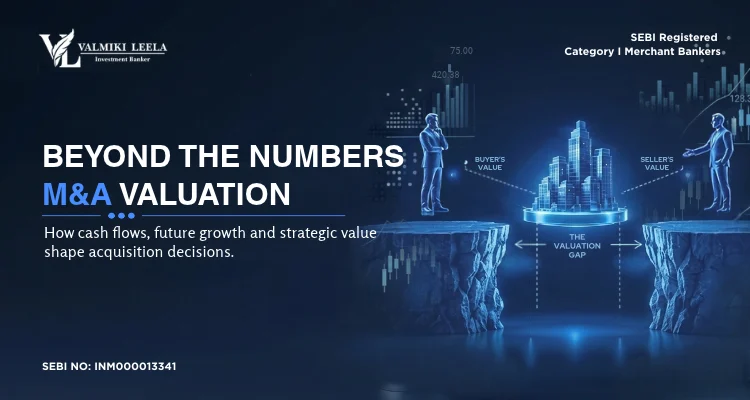
Beyond the Numbers: M&A Valuation. How cash flows, future growth and strategic value shape acquisition decisions.

Introduction
A business can be worth one number to its owner and quite another to a potential buyer.
For a promoter, the value may reflect years of building the business, earning customer trust, strengthening its market position and creating room for future growth. A buyer may look at the same business through its earnings, cash flows, capital requirements and the risks that lie ahead.
Neither view is necessarily wrong. The difference lies in what each side believes the business can deliver in the years to come.
This is where M&A negotiations can become challenging. Agreeing on the strategic fit is one thing; agreeing on the price is another. Ultimately, valuation goes beyond the numbers in a financial statement. It also depends on how both sides assess future potential, the risks involved and the value that can realistically be created after the deal.
Why the Same Business Can Have Two Very Different Values
A company’s value is not necessarily equal to the price its owner believes it deserves. Equally, a buyer’s initial valuation does not automatically represent the company’s intrinsic worth.
The difference often comes down to how each side assesses the future. The seller is generally focused on what the business can become. The buyer is focused on how much of that potential can realistically be captured, what investment will be required, and what risks come with achieving it.
That distinction is at the heart of many valuation discussions.
Sellers Often Value the Future. Buyers Often Anchor to the Present
Promoters who have built a business over many years often have a strong understanding of its future potential. They may have visibility into new markets, upcoming capacity expansion, large customer opportunities, new product launches, distribution growth or initiatives designed to improve margins. These opportunities may be commercially credible. However, a buyer may not assign full value to them until there is sufficient evidence that they can translate into sustainable earnings and cash flows.
This creates a fundamental difference in perspective:
- Seller: Values the business based on where it is going.
- Buyer: Values the business based on where it is today, adjusted for achievable future growth.
The valuation gap emerges in the space between these two assessments.
Growth Creates Value Only When It Creates Economic Returns
A business growing at 25% a year may look more attractive than one growing at 10%. But faster growth does not always mean a higher valuation.
What matters is how that growth translates into actual business performance. Is the company improving its margins? Is it generating enough cash? Does it need continuous investment to keep growing?
For instance, a business with ₹500 crore in revenue and healthy cash flows may be more attractive to an acquirer than one generating ₹700 crore but struggling to convert sales into cash.
Growth matters, but what a business earns from that growth matters just as much.
EBITDA Is an Important Anchor, But the Multiple Matters
EBITDA is one of the common starting points when valuing a business in an M&A transaction.
The calculation is straightforward: Enterprise Value = EBITDA × Valuation Multiple
For example, a business generating ₹50 crore in EBITDA would be valued at ₹500 crore at a 10x multiple.
But why 10x? Why not 8x or 12x?
That depends on how the business performs, how consistently it generates cash, its growth prospects, competitive position and the risks involved.
Two businesses may report the same EBITDA but attract very different valuations. The difference lies in how buyers assess their future potential and the confidence they have in sustaining that performance.
Cash Flow and Capital Requirements Can Change the Equation
EBITDA is not the same as cash. A business can report strong EBITDA while requiring significant investment in inventory, receivables, working capital or capital expenditure.
For a buyer, the more relevant question is ultimately how much sustainable cash the business can generate for its owners. Free cash flow, working-capital intensity, maintenance capex and future investment requirements can materially influence acquisition value.
This becomes particularly important when a seller presents an ambitious growth forecast. If achieving that growth requires substantial additional capital, the buyer may reasonably argue that projected earnings should not be valued as though they require no further investment.
The quality of earnings and the capital required to sustain them therefore becomes as important as the headline EBITDA figure.
Strategic Buyers May See Value That Financial Buyers Do Not
The identity of the buyer can also influence valuation. A strategic acquirer may be able to generate additional value from an acquisition through synergies that are not available to a financial investor.
These may include:
- Access to new customers or markets
- Geographic expansion
- Manufacturing capacity
- Technology and intellectual property
- Distribution capabilities
- Procurement efficiencies
- Cross-selling opportunities
- Cost synergies
- Supply-chain advantages
For example, a standalone business may be worth ₹500 crore based on its existing financial performance. A strategic buyer may believe it can generate an additional ₹30 crore of annual EBITDA through synergies.
That potential may justify a higher offer. However, the buyer is also assuming the execution risk associated with realising those synergies. The valuation discussion therefore becomes a question of how the incremental value should be shared between the buyer and seller.
Market Conditions Can Influence Valuation
Valuation is shaped not only by company fundamentals but also by the broader capital-market environment. When liquidity is strong, financing conditions are favourable and investor confidence is high, valuation multiples can expand.
Conversely, higher financing costs, market uncertainty or weaker risk appetite can lead to multiple compression even when the underlying business has not materially changed.
As a result, the same company can attract different valuations at different points in the market cycle. For sellers, this can be difficult to reconcile. The business may have delivered exactly as expected, yet comparable-company valuations may have moved lower.
Ultimately, valuation reflects both business fundamentals and the prevailing price of capital.
The Valuation Gap Is Often an Expectation Gap
Consider a hypothetical business generating ₹50 crore of EBITDA.
If the seller expects a 12x multiple, the implied enterprise value is: ₹50 crore × 12 = ₹600 crore.
If the buyer believes a 9x multiple is appropriate: ₹50 crore × 9 = ₹450 crore.
The resulting valuation gap is ₹150 crore. Simply negotiating over the multiple may not resolve the difference. The more productive approach is to understand what is driving each side’s valuation. Perhaps the seller expects EBITDA to reach ₹70 crore within two years, supported by a capacity expansion, new customer wins and margin improvement initiatives.
The buyer may agree with the underlying potential but remain unwilling to pay the entire premium upfront. This is where transaction structuring can help bridge the gap.
Structuring the Deal to Bridge the Valuation Gap
Price is not the only variable available to buyers and sellers. An earn-out, for example, can link a portion of the consideration to future performance.
Instead of paying the entire ₹600 crore upfront, the transaction could potentially be structured as: ₹450 crore at closing + ₹150 crore linked to agreed future milestones.
Depending on the transaction, these milestones could include EBITDA, revenue, free cash flow, customer additions, regulatory approvals, production capacity or other measurable strategic objectives.
Other mechanisms may include:
- Deferred Consideration: A portion of the purchase price is paid at a later date.
- Contingent Consideration: Additional consideration becomes payable when specified conditions are achieved.
- Escrow Mechanisms: A portion of the consideration is retained against defined risks or obligations.
- Rollover Equity: The seller retains an interest in the combined business and participates in future upside.
These structures can transform a binary disagreement over price into a mechanism for sharing risk and future value.
However, the effectiveness of such structures depends on careful documentation. Performance definitions, measurement periods, accounting policies, management control and dispute-resolution mechanisms must be clearly established.
Independent Valuation Can Bring Discipline to the Negotiation
When both parties have strong conviction around their respective numbers, an independent valuation can provide a more objective framework.
A robust valuation exercise may consider multiple methodologies, including:
- Comparable Company Analysis: How similar listed businesses are valued.
- Precedent Transactions: What buyers have paid for comparable businesses.
- Discounted Cash Flow (DCF): The present value of expected future cash flows.
- Asset-Based Valuation: The underlying value of assets and liabilities, where appropriate.
No single methodology should automatically determine transaction value.
The objective is to establish a defensible valuation range and understand the assumptions that drive it. This distinction is important because a valuation range is only as credible as the assumptions supporting it.
Look Beyond the Headline Transaction Value
A deal announced at ₹1,000 crore may not mean the seller receives that amount upfront. The actual payout depends on how the deal is structured.
Some of the consideration may be paid in cash, while some may come through shares, deferred payments or performance-linked earn-outs. The buyer may also take on debt, with adjustments for working capital or other agreed terms.
These details can make a significant difference to what the seller ultimately receives and what the buyer actually pays.
In M&A, the headline value tells only part of the story. The structure behind the number matters just as much.
Transaction Advisory Can Help Turn a Valuation Gap into a Deal
A valuation gap is rarely solved simply by producing another valuation report. The more important task is to identify the assumptions driving the difference between the two valuations.
These may relate to:
- Future growth
- Margin expansion
- Working-capital requirements
- Capital expenditure
- Market multiples
- Strategic synergies
- Customer concentration
- Management dependence
- Regulatory considerations
- Financing conditions
Once these drivers are understood, the parties can determine whether the difference should be addressed through price, transaction structure, risk allocation or deeper diligence. This is where transaction advisory can create meaningful value.
The role is not merely to arrive at a number. It is to help both parties understand what that number represents and determine how the valuation can be translated into a transaction that works commercially.
Conclusion
Valuation is often presented as a mathematical exercise. In an M&A transaction, it is much more than that. It brings together earnings, cash flows, growth, risk, strategic value and market conditions, along with the expectations of two parties looking at the same business from different positions.
The seller is realising the value of years spent building a business. The buyer is assessing what that business can deliver in the years ahead. Both perspectives matter, but bringing them together is rarely straightforward. Ultimately, a successful transaction is not just about arriving at a valuation both sides can accept. It is about finding common ground between the value created so far and the value that can realistically be created in the future.