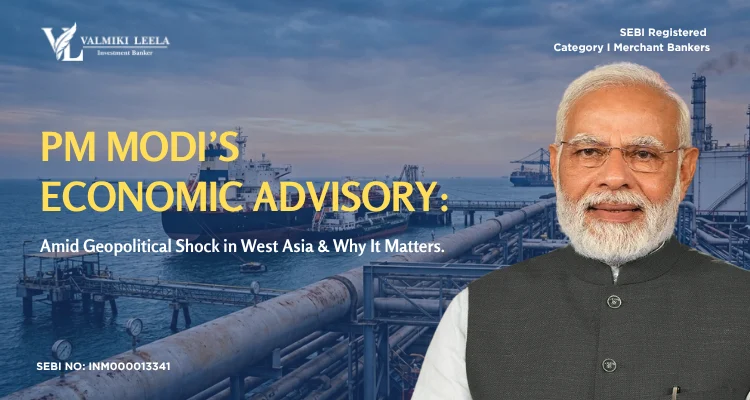
PM Modi’s Economic Advisory: Amid Geopolitical Shock in West Asia & Why it Matters

Introduction:
The recent advisory by Prime Minister Narendra Modi encouraging work-from-home practices, restraint on foreign travel and reduced gold purchases is not merely a lifestyle suggestion. It reflects a broader economic response to rising geopolitical uncertainty and energy-security concerns linked to the escalating conflict in West Asia.
At first glance, these measures may appear unusually cautious. But from a macroeconomic perspective, the logic behind them is both strategic and preventive.
What Triggered This Advisory?
The ongoing conflict in West Asia has heightened fears around:
- Crude oil supply disruptions
- Rising global energy prices
- Pressure on shipping and logistics routes
- Volatility in currency and commodity markets
For India, this matters significantly because the country imports a major portion of its crude oil requirements. Any sustained spike in oil prices directly affects: inflation, fuel costs, logistics expenses, fiscal stability, foreign exchange reserves.
At the same time, gold imports and foreign travel contribute to substantial foreign currency outflows. In periods of global instability, preserving forex reserves becomes economically important.
Why the Work-From-Home Push Makes Economic Sense
The revival of work-from-home is not being positioned as a pandemic response. It is being viewed as a fuel-efficiency and productivity strategy. Reduced commuting can lead to:
- Lower petrol and diesel consumption
- Reduced urban congestion
- Lower logistics pressure
- Controlled energy demand
At a national scale, even modest reductions in fuel usage can significantly ease import dependency during periods of crude volatility.
The government is effectively encouraging behavioural adjustments before economic stress becomes more severe.
Why Gold Purchases Were Specifically Mentioned
India is among the world’s largest consumers of gold. Large-scale gold imports increase pressure on the current account and foreign exchange reserves, especially during periods of rising oil prices.
By discouraging non-essential gold purchases temporarily, the government aims to reduce unnecessary forex outflows and stabilize macroeconomic pressure points.
This is less about restricting consumption and more about preserving financial resilience during geopolitical uncertainty.
Why Lower Foreign Travel Was Suggested
Foreign travel contributes to outbound forex spending through:
- Airline payments
- Overseas consumption
- Hospitality and tourism spending abroad
In an environment where oil prices, shipping routes and currency markets are under stress, limiting non-essential outbound expenditure becomes part of a broader conservation strategy.
The advisory also indirectly supports domestic tourism and local economic circulation.
How This Could Affect India’s Economy
Positive Implications
- Improved fuel conservation
- Reduced pressure on forex reserves
- Better resilience during global volatility
- Encouragement for domestic consumption and production
- Stronger focus on energy efficiency
Potential Economic Signals
The advisory also signals that the government is preparing proactively for a prolonged period of global uncertainty rather than reacting after severe disruption occurs.
Markets often respond positively when governments demonstrate early-stage macroeconomic preparedness.
The Bigger Picture:
This situation reflects how interconnected geopolitics and economics have become. A conflict thousands of kilometres away can influence:
- Fuel prices in India
- Inflation levels
- Import costs
- Investor sentiment
- Capital-market behaviour
The current advisory is therefore not simply about austerity. It is about economic resilience, resource optimization and protecting macroeconomic stability during a volatile global phase.
Conclusion:
The advisory reflects the government’s intent to encourage precautionary economic behaviour during a period of heightened geopolitical uncertainty and potential energy-market volatility.
Measures such as moderated fuel consumption, reduced non-essential forex outflows and greater operational flexibility through work-from-home are aimed at strengthening macroeconomic resilience in the short term.
At the same time, the long-term effectiveness of such behavioural advisories will ultimately depend on broader structural factors including energy diversification, domestic consumption strength, industrial productivity and global market stability.
As the situation evolves, policymakers, businesses and consumers alike will continue balancing economic caution with the need to sustain growth momentum and market confidence.