SpaceX’s Historic Nasdaq Debut: A Defining Moment for Innovation and Capital Markets

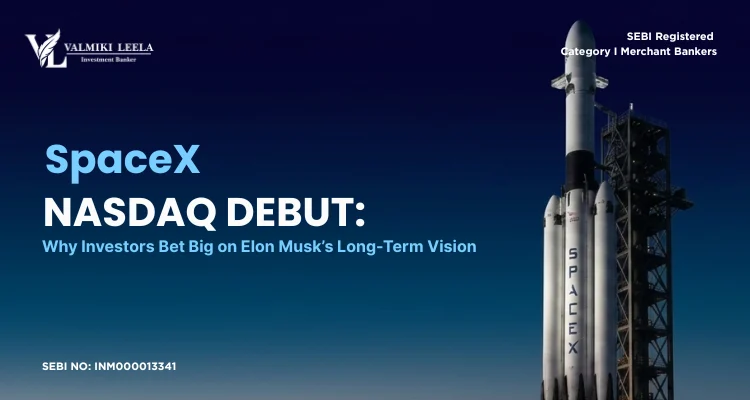
SpaceX’s Nasdaq listing is more than just a record-breaking public offering. It marks a turning point for global capital markets, showing how strongly investors back companies that push the limits of innovation and human progress.
Led by Elon Musk, SpaceX completed the world’s largest IPO, raising $75 billion at $135 per share. Strong demand from investors allowed underwriters to fully exercise the greenshoe option, adding another $10.7 billion and bringing the total proceeds to $85.7 billion.
The stock opened about 11% above its issue price and climbed to an intraday high of $168.75. This surge quickly added nearly $353 billion to SpaceX’s market value and, on paper, made Elon Musk the world’s first trillionaire.
Looking back on the journey, Musk said, “I’d given the company a 10% chance of success.
Beyond the headline numbers, the SpaceX IPO offers valuable insight into how modern markets reward innovation, strong execution, and a long-term vision.
Breaking Down the Numbers:
The transaction’s scale dwarfs previous record IPOs and highlights exceptional appetite for category-defining businesses. SpaceX is not just another aerospace firm. Investors are pricing in a diversified, high-growth ecosystem.
Why the Greenshoe Option Matters:
The full exercise of the greenshoe (overallotment) option underscores robust demand. This mechanism lets underwriters’ issue extra shares to stabilize trading and support orderly price discovery when enthusiasm exceeds supply. In SpaceX’s case, the additional $10.7 billion raised signals deep, high-quality institutional interest.
Why the Market Value SpaceX Differently:
SpaceX earns premium multiples because investors see far more than rockets. They are backing an integrated platform across:
- Reusable launch systems
- Starlink satellite internet services
- Defence and government contracts
- Space infrastructure and logistics
- Data and connectivity solutions
- Future lunar and interplanetary missions
Markets increasingly reward companies that create and dominate new industries rather than competing in established ones. Valuation here emphasizes future optionality and network effects over near-term earnings.
Why Musk Chose a Full SpaceX IPO Over Starlink Alone:
Many expected a standalone Starlink listing due to its recurring subscription revenue. Instead, SpaceX listed the entire organization. This choice broadened the investment thesis dramatically.
A Starlink-only IPO would have limited exposure to one segment. The full listing lets investors own the synergies across launch, connectivity, defence, and exploration. Key advantages include:
- Integrated valuation as a complete technology and infrastructure platform
- Greater capital allocation flexibility across segments
- A compelling narrative of long-term, multi-decade growth
Capital markets often assign higher multiples to integrated platforms with optionality than to siloed businesses.
Understanding Investor Demand:
Demand reflected more than hype. It showed confidence in execution capability. Large IPOs succeed through participation by sophisticated, long-term capital aligned with the company’s trajectory. Quality of investors often matters as much as quantity.
What Should Investors Do Right Now?
Enthusiasm is natural after such a debut, but discipline matters. Key considerations include:
- Valuation: Does the market capitalization fully price in ambitious growth targets?
- Business mix: How is value split between core launch, Starlink, and frontier opportunities?
- Execution risk: Can SpaceX consistently hit technological and commercial milestones?
- Governance: How does founder-led decision-making influence long-term outcomes?
- Volatility: Limited float and future lock-ups may drive short-term swings.
Newly public high-growth companies frequently experience volatility as reality meets expectations. History shows strong businesses do not always deliver strong returns at any price.
Should You Buy SpaceX After Its IPO?
There is no one-size-fits-all answer. It depends on risk tolerance, time horizon, and portfolio fit. Long-term investors should assess whether technological leadership translates into durable cash flows. Short-term traders will watch sentiment and liquidity.
At current levels, much of the vision may already be priced in. Future returns hinge more on proven execution than narrative alone. An extraordinary business does not guarantee an extraordinary investment at every valuation.
My View: The Biggest Driver of SpaceX’s Valuation:
What do I believe is the bigger driver of SpaceX’s valuation: technological leadership, market opportunity, or investor conviction in Elon Musk’s long-term vision?
All three interplay, but investor conviction in Elon Musk’s long-term vision stands as the primary driver, amplifying the other two.
Technological leadership is real and impressive. Reusable rockets slashed launch costs dramatically, Starlink delivers connectivity in remote areas, and the company’s rapid iteration sets industry standards. Without proven engineering breakthroughs, none of this valuation would exist.
The market opportunity is enormous: global internet access, satellite mega-constellations, space economy growth, defence needs, and multi-planetary ambitions. These secular tailwinds justify substantial multiples.
Yet the decisive factor is deep investor faith in Musk’s ability to execute audacious, multi-decade goals. Markets have repeatedly rewarded his track record across Tesla, SpaceX, and other ventures. This conviction turns technological feats into perceived inevitabilities and vast opportunities into investable realities. It explains why SpaceX commands a premium that values ecosystem synergies and future optionality more generously than peers.
Musk’s vision provides the narrative glue. It attracts talent, capital, and partnerships while sustaining tolerance for high execution risk. Without this belief, the same technology in a different corporate culture might trade at a fraction of the valuation.
This dynamic reflects broader market trends: in frontier sectors, founder vision and execution credibility often become the scarcest, highest-leverage assets.
Our Perspective:
As a SEBI Registered Category I Merchant Banker, Valmiki Leela Capital views enduring valuations as products of vision, governance, execution, and investor confidence. The SpaceX IPO reinforces timeless principles:
- Strong narratives require strong fundamentals.
- Capital flows to businesses with clear, long-term visibility.
- Conviction outweighs short-term excitement.
- Sustainable value builds over years, not in a single listing event.
While few companies will match SpaceX’s scale, the lessons apply universally. Markets ultimately reward those who convert ambition into consistent, measurable outcomes.
This analysis is for informational purposes and does not constitute investment advice. Always conduct your own due diligence.