India EV Market 2026: 2.45 million Sales & The Inflection Point

Introduction
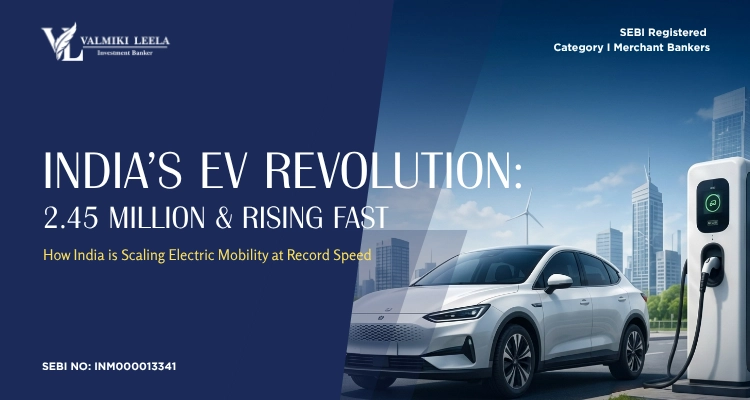
India’s mobility story is changing faster than most realise. Just a decade ago, electric vehicles (EVs) were a niche experiment. Today, India ranks among the world’s fastest-growing EV markets. In the 12 months ending March 2026, over 2.45 million EVs were registered, pushing overall EV penetration to around 8.3% of total vehicle registrations.
This is no longer early adoption. India’s EV transition has reached a true inflection point.
The Numbers Driving Momentum
India’s EV story is accelerating fast.
Monthly EV sales climbed from 1,69,355 unit in April 2025 to 2,79,530 unit in March 2026, reflecting both rising adoption and a rapidly maturing market.
Electric two-wheelers continue to dominate with 1.28 million unit sold, accounting for 57% of total EV sales. Three-wheelers followed with 0.8 million units, contributing 35% and reinforcing the strength of last-mile and urban mobility demand.
The most interesting shift, however, is happing is passenger vehicles.
While electric car volumes remain smaller at around 1,75,000 units, the segment scaling quickly. January 2025 recorded a 51% year-on-year jump in electric car sales, driven by premium models offering better range, technology, and performance.
What began as a cost-saving mobility trend is now evolving into a full-scale transformation of India’s automative landscape.
Policy Framework Powering the Shift
India’s EV surge is not happing by accident. It is the result of a coordinated policy push designed to build the entire ecosystem at once.
The government is simultaneously driving consumer adoption, local manufacturing, and charging infrastructure through multiple large-scale initiative:
- PM E-DRIVE Scheme (₹10,900 crore, launched October 2024) Supports EV adoption across two-wheelers, three-wheelers, trucks, and ambulance, while allocating ₹2,000 crore for more than 72,300 public charging stations. The scheme runs until 2028.
- ACC PLI Scheme (₹18,100 crore) aims to create 50 GWh of domestic batter cell manufacturing capacity.
- Auto & EV PLI Scheme (₹25,938 crore) incentives production of critical EV components, motors, and battery systems.
- Tax Advantages: EVs attract 5% GST compared to 28% for petrol and diesel vehicles.
Recent budget measures, including duty exemptions on battery manufacturing equipment and critical minerals, further strengthen India’s domestic supply chain ambitions.
The large objective goes beyond cleaner mobility. A stronger EV ecosystem reduces dependences on imported crude oil, improves energy security, builds manufacturing capability, and positions India as a serious player in the global mobility transition.
Building Infrastructure and Confidence
Range anxiety is no longer the biggest hurdle for EV adoption.
Over 9000 public charging station have already been sanctioned, with thousands more planned across key highways and economic corridors like Delhi-Chandigarh, Delhi-Jaipur-Agra, and Mumbai-Pune.
India is also working to avoid a new wave of import dependence. A strong Domestic Content Requirement for critical EV components is encouraging local manufacturing, while investments in domestic battery production are expected to lower costs over time.
The EV story is no longer just about vehicles. It is about building the infrastructure, supply chain, and manufacturing ecosystem needed for long-term scale.
A Market in Motion
Competition is intensifying across India’s EV Landscape. In the four-wheeler’s segments, new entrants are quickly gaining market share with feature-rich, compelling models. The two-wheelers space is also evolving fast, driven by better range, faster charging, and smarter connectivity. Meanwhile, commercial use cases such as electric three-wheelers and last-mile delivery vehicles are steadily expanding, as fleet operators increasingly recognize clear cost advantages.
The Road to 2030
India’s EV transition is being driven by clear and ambitious adoption targets across key segments.
The vision includes 80% electrification of two- and three-wheelers, 40% for buses, and 30% for private cars. Together, these targets signal a rapid shift in how India will move people and goods over the next decade.
Market projections reflect this momentum, with the EV sector expected to surpass USD 110 billion by 2029. However, the real determinant of success will be cost. Batteries alone make up 40 to 50% of an EV’s total price, making affordability heavily dependent on continued price reductions.
This is where scale and domestic manufacturing become critical, reducing import dependence while driving down costs and strengthening long-term competitiveness.
Bottom Line:
India’s experience offers three clear lessons about how electric mobility scales.
First, starting with high-volume, everyday segments such as two-wheelers and three-wheelers helps people quickly adopt and trust electric technology. It makes EVs visible, practical, and part of daily life.
Second, progress accelerates when demand incentives, manufacturing support, and charging infrastructure move together. When these elements are aligned, adoption picks up far faster than when they are rolled out one after another. Third, change does not always happen gradually. Once multiple conditions fall into place, markets can shift quickly and reach tipping points sooner than expected.
Taken together, India is doing more than just adopting electric vehicles. It is building an entire industrial ecosystem spanning batteries, components, and finished vehicles. This shift is steadily positioning the country as a rising force in global mobility, with roads that are becoming quieter, cleaner, and increasingly electric.