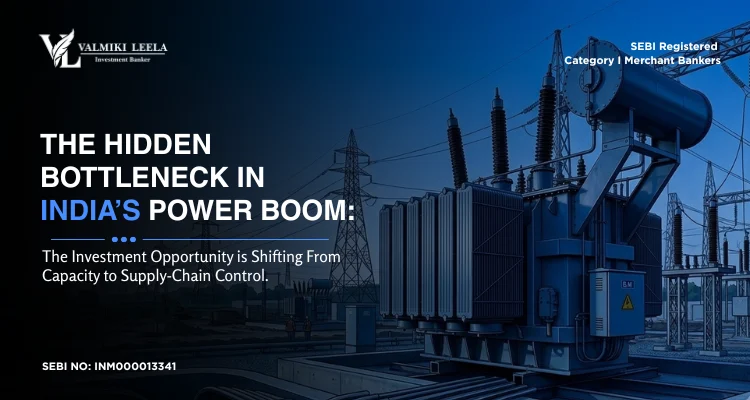
The Hidden Bottleneck in India’s Power Boom: The investment opportunity is shifting from capacity to supply-chain control

Introduction:
India is building grid infrastructure at a pace it has never attempted before, and the equipment that makes that grid work is running into a wall well before the wires do. Substation capacity additions are behind schedule even as capex targets keep rising, and the reason has little to do with land, funding, or approvals. It comes down to a copper conductor most investors have never heard of.
The Transmission and Transformer Investment Cycle:
India's transmission build-out is now a headline capital markets theme. Industry estimates put transmission investment at roughly ₹5-6 trillion between FY27 and FY32, largely to support the country's growing renewable capacity. With India targeting more than 900 GW of non-fossil capacity by 2035-36, the transmission network will have to keep pace, especially as solar and wind alone could account for around 548 GW. Meeting this requires annual additions of around 20,000 circuit kilometres of transmission lines and 120 GVA of substation capacity. A separate estimate puts the opportunity as high as ₹7.6 trillion between FY27 and FY32. The exact figure varies by source, but the direction is clear: this is shaping up to be a multi-year, multi-trillion-rupee cycle, not a one-time spending spike.
Execution is already lagging the plan. India added 35,670 MVA of new transformation capacity at 220 kV and above in the first four months of FY27, around 66% of what was planned for the period, with the largest central-sector player contributing the biggest share. The full-year FY27 target is 158,339 MVA, compared with just 113,013 MVA added in FY26. The gap between ambition and delivery is the real story, and it traces back to a single, underappreciated input.
Why CTC is Critical to Large Power Transformers:
Continuously Transposed Conductor, or CTC, is the copper winding material used in every large power transformer above roughly 50 MVA, as well as in generator step-up transformers and HVDC equipment. It is made from dozens of enamel-insulated rectangular copper strands, mechanically transposed so each strand moves through every position in the bundle. That helps reduce circulating-current losses and allows transformers to operate efficiently at high voltage at this scale, there is no easy substitute for CTC that meets the required specification.
That makes CTC a structural chokepoint, not just another input. Transformer manufacturers can switch vendors for components like enclosures, oil or bushings relatively easily. CTC and its core-material counterpart, CRGO electrical steel, are different. Both require long-lead, specification-matched procurement, and a shortage in either can hold up an entire transformer even when everything else is ready.
A Concentrated Supply Base and High Entry Barriers:
Indian CTC manufacturing is still a relatively small market. The reason is not a lack of demand the entry barriers are simply high. CTC requires specialised transposing machinery, precision enamel insulation that can handle thermal classes up to 200°C, and a long qualification process before transformer manufacturers are willing to approve a new supplier. Adding capacity is therefore not something that can happen overnight.
The same challenge exists with CRGO electrical steel, which forms the magnetic core of a transformer. India consumes roughly 400,000 to 450,000 tonnes a year, while domestic production is only around 40,000 to 50,000 tonnes, leaving the country heavily dependent on imports. For some of the most efficient, low-loss transformers, the required high-grade CRGO still has to come from outside the country.
This is where the real bottleneck sits: for the power-transmission opportunity to translate into actual transformer capacity, having capital and manufacturing capacity is only part of the equation. The harder question is whether the right raw materials can be secured, qualified and delivered on time.
Copper Dependence and the Case for Backward Integration:
CRGO alone can account for 30 to 40% of a transformer's material cost, so supply disruptions or tariff changes can quickly put pressure on OEM margins. CTC is similarly exposed, given how copper-intensive its production is, making both inputs sensitive to global commodity price swings.
This makes backward integration increasingly important. Manufacturers with captive CTC capacity or long-term copper sourcing arrangements can better manage price volatility, supply constraints and delivery timelines. For investors, this is more than a margin story; control over critical inputs can become a competitive advantage in a transformer market where execution and timely delivery matter.
Global Transformer Shortage Creating Export Opportunities:
India's bottleneck comes against a backdrop of even tighter shortages abroad. US power-transformer lead times have exceeded 100 weeks since 2023, with some estimates suggesting they now stretch close to four years for high-capacity units, while Europe faces similarly long backlogs. Industry research points to a meaningful supply shortfall in US power transformers, compounded by a large share of the country's distribution fleet already being beyond its service life.
This global squeeze is creating an opportunity for Indian manufacturers. Capacity across listed domestic and multinational transformer players operating in India is expected to expand by roughly 200 to 220 GVA over the next two to three years, supported by domestic grid investment and rising export demand. India is effectively building for two grids at once, its own and a growing share of global demand, while CTC and CRGO remain the tightest links in the supply chain.
What investors should Watch:
Three signals can separate durable winners from capacity announcements that do not translate into delivered MVA:
- Backward integration into CTC and copper processing: Captive or related-party sourcing can improve execution reliability, not just margins.
- CRGO sourcing and BIS certification: Regulatory clearance and diversified sourcing are increasingly important for order-book visibility.
- Export mix and global OEM qualification: Relationships with major international transformer manufacturers indicate that a company has cleared demanding technical standards and can access premium export orders.
The transformer story is usually framed around demand from GW targets to capex and substation additions. For investors, the more important question may be what sits underneath that demand. In a supply-constrained market, the advantage could belong to manufacturers that control critical inputs like CTC and copper, not just those adding capacity.
Key Takeaway:
India’s power-transmission opportunity is massive, but execution will depend on more than capex and capacity additions. CTC, copper and CRGO are emerging as critical supply-chain bottlenecks. For investors, the real differentiators may be backward integration, raw-material security, technical qualifications and the ability to deliver transformers on time. In a supply-constrained market, controlling the bottleneck could matter more than simply adding capacity.