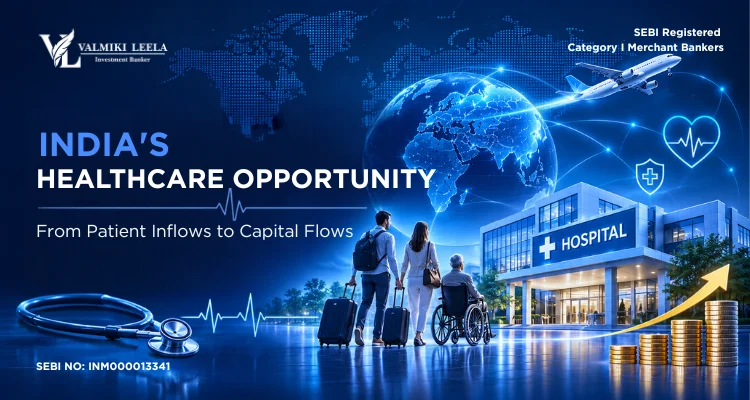
India’s Healthcare Opportunity: From Patient Inflows to Capital Flows

Introduction:
A knee replacement in the United States costs around ₹40 lakh. In India, the same procedure costs ₹2-3 lakh. That is roughly one-thirteenth to one-twentieth of the price.
That gap explains why more than 5 lakh foreign patients travelled to India for treatment last year. It also points to a bigger shift. Healthcare is turning into an export industry.
Why a patient counts as an export
When we think of exports, we picture software, pharmaceuticals, textiles and engineering goods. But when a patient from abroad flies in, pays for treatment at an Indian hospital and flies’ home, that is a services export. Foreign exchange comes into the country. The cash register is a hospital billing desk instead of a shipping port.
Most people do not think about medical travel this way. It usually gets discussed as a health story or a tourism story. It is also a trade story.
The size of the opportunity
Government estimates put India’s medical tourism market at about $8.7 billion in 2025, rising to $16.2 billion by 2030 (roughly ₹84,000 crore to ₹1.56 lakh crore). That is close to doubling in five years, or about 13% a year.
The logic behind the number is simple. India offers a combination few countries can match. Qualified specialists, large-volume hospital experience, specialised centres and prices far below those in developed markets. Patients who face long waiting lists or unaffordable bills at home notice that.
India has built a real presence in cardiac care, orthopaedics, organ transplants, oncology and fertility treatment. These are complex, high-value procedures where experience and cost both matters.
Government support is adding momentum
Demand alone does not build an industry. Access, infrastructure and ease of travel matter too. The government has started to address them.
Union Budget 2026-27 proposed a scheme to help states set up five regional medical hubs with the private sector. They are meant to combine hospitals, diagnostics, research, rehabilitation and AYUSH centres into integrated healthcare destinations.
Visas are the second piece. The e-Medical Visa and e-Medical Attendant Visa are available to citizens of over 170 countries. The attendant visa matters more than it looks. Patients rarely travel alone, and a family member's ability to come along often decides where treatment happens.
These are early steps, but they point in a consistent direction. Policy support will only go so far, though. Treatment quality, international accreditation, transparent pricing, patient safety and reliable post-treatment care are what build a reputation. They take time.
It is not just a hospital story
When people hear medical tourism, they think of large hospital chains. But a patient's journey does not begin and end in the operating theatre.
A foreign patient needs diagnostics before the procedure. Specialist consultations. A recovery period, rehabilitation and follow-up care. Often medical equipment and support services as well. Every one of those touchpoints is a business.
Diagnostic centres could see more demand for advanced testing. Specialised clinics may benefit from the preference for focused treatment. Rehabilitation facilities become more important as patients look for structured recovery. Around them sits a supporting layer of healthcare technology providers, equipment companies, patient management platforms, staffing businesses and travel and stay services.
This makes the opportunity broader than a handful of large hospital operators. Growth can reach several specialised businesses across the chain.
What this could mean for capital
For investors, the rise of medical tourism as an export industry raises a practical question. Which parts of the healthcare value chain are best placed to benefit?
Capacity expansion, specialised treatment facilities, diagnostic infrastructure and rehabilitation services may all need fresh capital as demand grows. Some established companies may expand organically. Others may look at acquisitions to enter new markets or add specialisations. Smaller regional operators may look for institutional capital to scale.
From a capital markets perspective, this creates opportunities at different stages of a business. Established players may look at private equity or public market fundraising to finance expansion. Smaller players may look at strategic partnerships or consolidation.
But rising demand alone does not guarantee attractive returns. In my experience, the questions that matter are operational. How is the hospital occupancy? What are the capital expenditure requirements? Is doctor availability a constraint? What do margins look like, and can treatment standards hold while the business expands?
The businesses that combine clinical credibility with financial discipline are likely to be better positioned. Investors will be watching to see which parts of the chain build durable, repeatable international revenue.
The road ahead
India's healthcare export story is still developing. The cost advantage is strong and the medical talent base is established. Competing globally will need continued investment in infrastructure, technology, specialised capabilities and patient experience. It will also need greater confidence among international patients, built through transparent processes, recognised standards and continuity of care.
For a long time, the story of Indian healthcare was about serving a vast domestic population. That story continues, and it still has plenty of room to grow. But the next phase may look different. Growth may come not only from treating more patients at home, but from serving a growing base of patients from abroad.
Healthcare is no longer only a cost centre or a social good. It is becoming one of the ways India earns from the world.